
Kakobuy Shipping, Weight, Customs & Taxes: Full Guide
The shipping stage is where costs and customs come in. This guide covers submitting a parcel and pickup timing, what can and can’t be shipped, how declaration and customs risk work, when a tax number is required, and how Kako package insurance compensates for delays, holds and loss.
Once your goods are in the warehouse and marked “can submit parcel”, you choose a shipping line, declare the parcel and pay freight. What you pay depends on chargeable weight and route; what arrives smoothly depends on declaration, restrictions and — for some countries — a valid tax number. Here’s the whole picture.
Submitting a parcel, chargeable weight & pickup timing
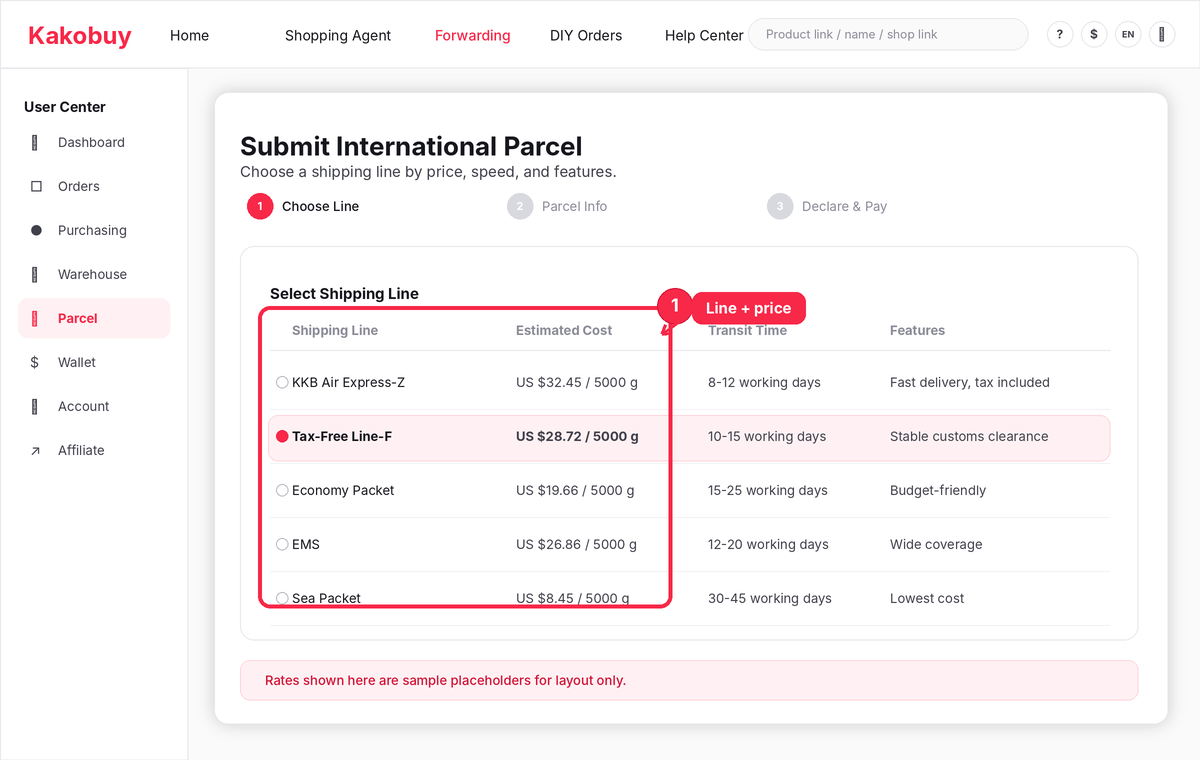
When your goods are marked “can submit parcel”, you select the items, enter your address, and choose a shipping line — each line shows an estimated cost, transit time and features (tax-free, fast, budget, etc.). After you submit, Kakobuy ships it out within 24 hours, and the courier arranges pickup within 2 working days (couriers don’t run on weekends and public holidays, so pickup shifts past those days).
How shipping cost is calculated: chargeable weight
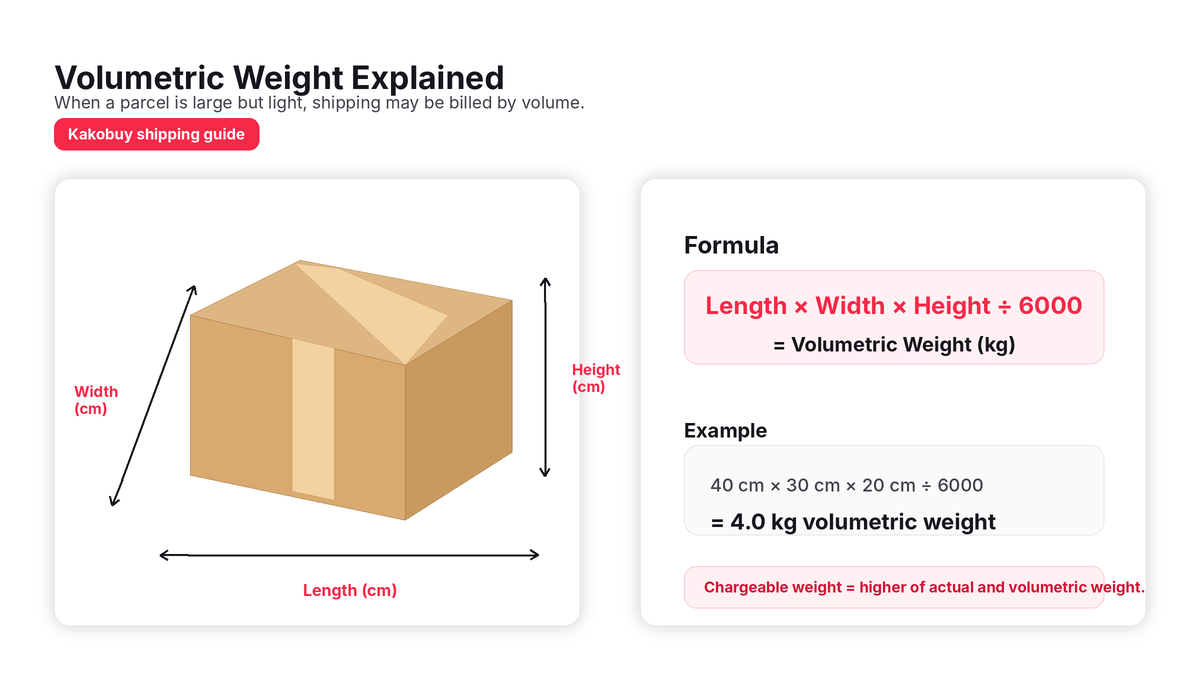
Freight is billed on chargeable weight — the greater of actual weight and volumetric weight. Volumetric (dimensional) weight accounts for parcels that are large but light:
Volumetric weight (kg) = Length × Width × Height (cm) ÷ 6000. Example: a 40 × 30 × 20 cm box = 4.0 kg volumetric. If its actual weight is only 2.5 kg, you’re billed on the higher 4.0 kg.
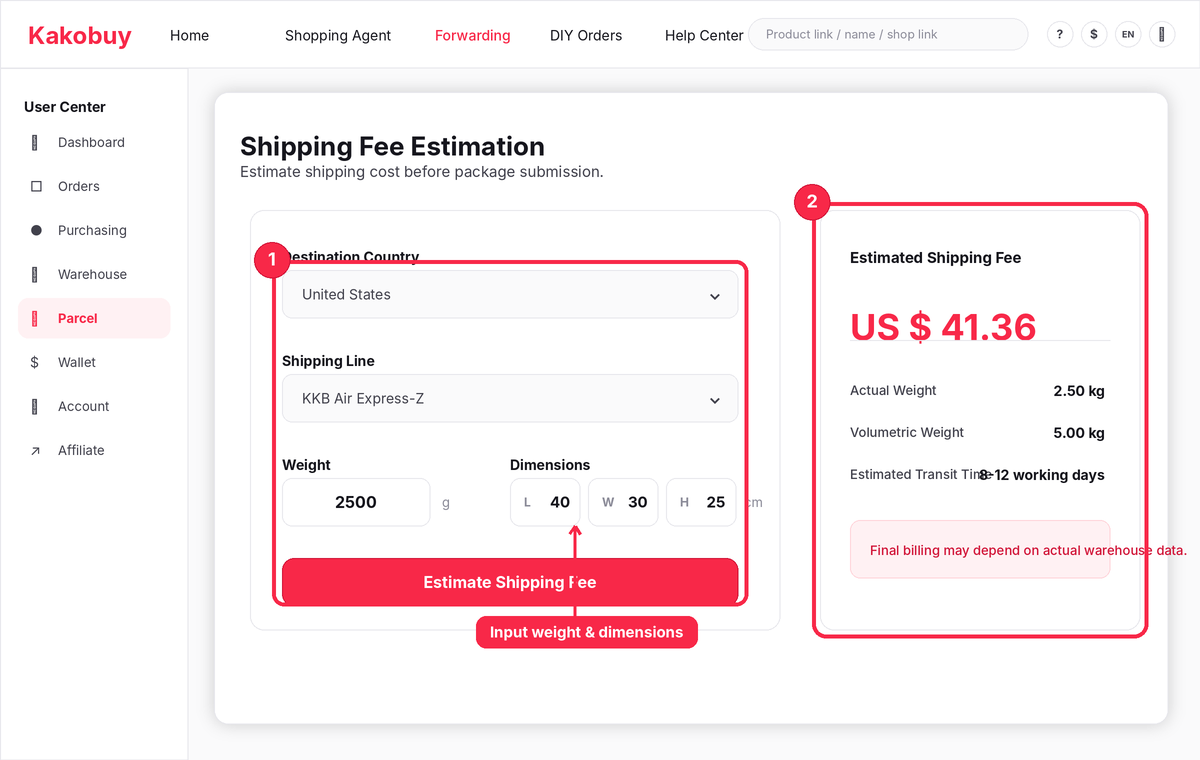
Use the shipping-fee estimate tool to preview cost by destination, line and dimensions before you commit. Because the warehouse re-measures the packed parcel, the final freight can differ slightly from the estimate — keep a small balance topped up so a parcel isn’t held for a late payment.
What can’t be shipped (restrictions)
If some items in your warehouse can’t be submitted together, it’s usually because one or more of them carry mailing restrictions and are blocked at the waybill stage.
Goods must comply with the laws of China and the import rules of the destination country. Broadly prohibited categories include:
- Weapons, imitation weapons, ammunition and explosives.
- Counterfeit currency or securities.
- Narcotics and psychotropic substances (opium, morphine, heroin, cannabis, etc.).
- Potent poisons and hazardous chemicals.
- Materials harmful to public morals, or that involve state secrets.
- Endangered species, precious cultural relics, and items with dangerous pests or pathogens.
Different shipping lines also restrict things like liquids, powders, batteries and branded goods. If an item won’t submit, check the line’s restrictions or switch to a route that accepts it.
Declaration guidelines by route
Declaration — the value and description recorded for customs — is handled per shipping line, because each route has its own declaration rules and destination-country requirements. Kakobuy declares based on the actual value of the goods, combined with the logistics provider’s requirements and each country’s tariff thresholds.
On the package submission page, each route shows its specific declaration guidance (look for the information/green icon at the bottom of the route). If you know your local customs policy, you can add a note on the parcel to indicate the declared value you prefer.
Customs risk: taxes, inspection & how to lower it
For purchasing and transshipment orders, once goods reach the warehouse Kakobuy chooses lower-customs-risk transport based on the cargo type and its experience — but no agent can eliminate customs risk. Returns, fines or taxes remain the customer’s responsibility.
How declaration and risk work in practice:
- Kakobuy declares based on the goods’ actual value, the logistics provider’s requirements and each country’s tariff thresholds.
- The heavier the parcel or the higher the value, the greater the chance of being taxed or inspected.
- To reduce risk, avoid parcels that are very heavy or hold many identical items.
No agent can guarantee 100% that a parcel won’t be taxed or held. Treat any duty as a possible cost of international shipping, especially on large or high-value orders.
Customs clearance instructions
Non-tax-free routes: clearance costs are borne by the recipient. Inspection is usually random, but if customs considers a parcel special (large, heavy, or containing sensitive goods) they may contact the recipient for invoices or clearance documents. If the recipient can’t be reached or doesn’t engage with customs, any resulting return or destruction cost falls on the recipient.
Tax-free routes: Kakobuy assists the logistics company with clearance. In special cases the recipient may still need to help; genuine clearance expenses can be reimbursed with the relevant vouchers.
For purchased goods, if customs asks for proof of payment, Kakobuy can provide a screenshot of the payment order only — not a formal invoice or receipt.
When you must provide a tax number
Some countries require a valid tax identification number before a parcel can ship or clear customs. Without it, parcels may be delayed, undeliverable, or returned. Examples include Chile (RUT) and Brazil (CPF for individuals, CNPJ for companies), each with its own format.
Why it matters:
- Smooth clearance — in some regions the tax number is mandatory customs information.
- Avoiding delays — parcels without one may not be delivered on time and can be returned.
- Legal shipping rules — some regions legally require a valid tax number to ship.
If your destination requires one, add it to your account/parcel details early. Unsure how to format it? Ask Kakobuy’s online customer service.
Kako package insurance & compensation
Kako Insurance is an optional add-on at parcel submission that covers three risks:
- Delay insurance — if a parcel exceeds its route’s delivery window (30 or 40 days from shipment, depending on route), you’re compensated 20% of the shipping fee.
- Customs-hold insurance — if customs detains the parcel, compensation is based on the situation and the route’s criteria.
- Loss/damage insurance — if the parcel is lost or damaged, compensation follows the situation and the route’s criteria.
When insured, compensation is based on actual shipping fee + actual value of goods, up to the insured amount. If a delay payout is made first and the parcel is later lost or held, the delay compensation is deducted from the final payout. Per-route criteria appear inside the green icon at the bottom of each route on the submission page, and coverage by destination can be checked via the shipping estimate tool.